
A case against the digital euro
Implications of Centralized Digital Money for Economic Freedom, National Sovereignty, and Human Dignity

The technology of the digital euro, designed, developed, and promoted by the European Union, or more precisely, by the European Central Bank, is likely to be rolled out across Europe in the coming years. The digital euro is one variant of the broader concept of so-called central bank digital currency (CBDC), which has already been introduced, under various names, in several non-European countries: the Bahamas, Nigeria, Jamaica, and, more recently, Zimbabwe.
What makes central bank digital currencies particularly problematic is their impact on three key areas: (I) the erosion of individual economic freedom, (II) the further undermining of national monetary sovereignty, and (III) an attack on human dignity within a technocratic socio-political framework. Before delving into the specifics of central bank digital currencies, it is necessary to conceptually distinguish them from digital money in general.
Digital Money vs. Central Bank Digital Money
Many of the risks discussed here, particularly those related to user privacy, do not apply exclusively to CBDCs but also affect existing forms of digital money used via bank cards. The key difference between digital money and central bank digital money lies in ownership. While traditional digital money has been either dispersed or at least formally decentralized, central bank digital currencies are, as the name suggests, centralized, and in the case of the digital euro, this centralization is embodied in the European Central Bank.
This form of ownership gives rise to fundamentally different risks. For instance, regarding privacy, which is a pervasive concern in the digital sphere, there is a significant difference for the end-user between someone tracking transactions for relatively benign commercial purposes, such as sending personalized advertisements, analyzing consumer habits, or monitoring purchased quantities, and far more dangerous surveillance aimed at assessing political compliance or loyalty.
Philosopher John Lennox summarizes this distinction as the difference between surveillance capitalism, which characterizes the value-depleted West, and surveillance communism, exemplified by China, where the state effectively controls all key technological tools and can implement a dystopian social credit system. According to Lennox, the European Central Bank’s digital money can be seen as a state-led competitor to corporate, omnipresent digital money, gradually shifting Western surveillance capitalism toward a model of surveillance communism.
The common denominator of both systems is the attack on privacy, while the difference lies in how quickly and effectively that privacy is compromised, and for what purposes.
I. Erosion of Economic Freedom
CBDCs, and therefore the digital euro, directly threaten the classical understanding of individual economic freedom. Here, economic freedom is not understood in today’s terms; as purchasing power or the amount of goods and services one can consume (simply put: income), but as the capacity for economic self-sufficiency: the ability to provide for oneself and one’s family without constant dependence on external centers of power, whether political or corporate.
Viewed this way, economic freedom is already seriously compromised. Most citizens depend, to some degree, on decisions made by state or supranational structures on one hand, and by corporate interests (employers) on the other. Introducing a central bank digital currency would further weaken this already fragile freedom, as the practical prerequisite for CBDCs is the implementation of a so-called digital identity. While European proponents claim that the digital euro can technically be implemented without full centralization of personal data, experience and legal frameworks suggest otherwise. None of the countries that have introduced a CBDC did so without first or simultaneously implementing digital identity.
Requiring a digital identity as a condition for participating in economic life effectively eliminates economic freedom. Individuals no longer have a direct link between their labor and its fruits; every economic action—employment, wage receipt, and spending—is conditional on system approval. Examples from the pandemic illustrate how quickly and broadly such mechanisms can be abused. The Canadian case of freezing protesters’ private accounts is only a preview of what becomes possible in a fully centralized and programmable monetary system.
Economic freedom does not exist where participation in economic life depends on political compliance or technical authorization. In such a system, a person cannot be self-sufficient and becomes perpetually dependent on the goodwill or discretion of state and supranational structures.
II. Further Undermining National Monetary Sovereignty
By definition, a central currency intrudes upon a nation’s sovereignty. In Croatia, we experienced this, at least those less cautious of us who advocated for and implemented the euro, when the Croatian kuna was replaced by the EU’s supranational currency. This placed the European Central Bank at the helm of the overarching monetary authority.
Introducing a central digital euro would further limit our country’s ability to independently manage its fiscal and monetary policies, rendering the Croatian National Bank effectively redundant. Currently, the bank serves as a kind of intermediary between European structures and Croatia, but its role has largely been symbolic. With the digital euro, even this symbolic role disappears.
Croatian citizens would then be directly dependent on decisions made by the European Union, receiving money directly from it. How much money there will be, how it will be managed, who will limit eurocratic power in the context of programmable money, and what monetary decisions will be made during future crises—all of these would fall under the jurisdiction of Ursula von der Leyen and Christine Lagarde.
Full digitalization of money, particularly through centralized digital currencies or private payment systems, shifts real power from democratically accountable institutions to technocratic, supranational, and corporate structures of questionable legitimacy. Maintaining cash in such conditions ensures the resilience of the financial system, societal continuity in crises, and democratic oversight of fundamental economic processes.
III. Technocratic Attack on Human Dignity
Human dignity in a hyper-technologized world requires that individuals not be reduced to mere data points or manageable system resources. Subordinating humans to technology is a process of technocratic dehumanization. In this context, CBDCs directly undermine human dignity on three levels:
Privacy
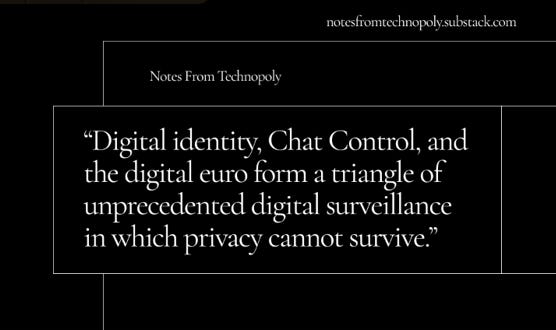
CBDCs eliminate legitimate financial anonymity in daily transactions. Every use of money is permanently recorded, analyzed, and potentially profiled, normalizing financial surveillance and systematically eroding privacy as a foundation of a free society. This problem is inseparable from other contemporary digital privacy attacks, such as the controversial Chat Control regulation proposed around the same time as the digital euro. Digital identity, Chat Control, and the digital euro form a triangle of unprecedented digital surveillance in which individual privacy practically ceases to exist.
Autonomy
CBDCs prevent direct and unconditional control over personal financial resources. Autonomy, in the broader sense of freedom, is understood here as the ability to act in the world according to one’s own values. The technical architecture of digital money allows access to personal funds to be conditioned, limited, or suspended, subordinating the right to manage one’s labor and assets to the system’s rules and intermediaries’ will. China’s social credit model, mirrored phenomenologically in Western “carbon currency” proposals, illustrates the complete loss of autonomy in a technocratic system, where acting according to personal conscience depends on credits that, once exhausted, can instantly impoverish an individual.
Resistance to Human and Monetary Resource Exploitation
According to foundational works in philosophy of technology, introducing new technologies not only applies the technology but changes societal assumptions. CBDCs redefine money, turning it from a symbol of exchange between individuals into a programmable resource controlled and monitored by supreme authorities, treating money users (i.e., citizens) as resources of the ruling regime and its value system. Social credit systems exemplify this perfectly.
***
All of the above, particularly (I) the erosion of economic freedom, (II) further undermining of national monetary sovereignty, and (III) the technocratic attack on human dignity, point to a categorical rejection of the digital euro and the concept of CBDCs more broadly.
In responding to such globalist proposals, one should remember the inadvertently revealing guidance of former European Commission President Jean-Claude Juncker, the famous eurocrat and wine enthusiast, who once humorously exposed how decisions are made in the EU: the bureaucracy first decides something, then announces it to the public, and patiently observes the majority’s reaction. If there is no particularly loud opposition, Juncker admitted, the decision is almost automatically adopted. Paradoxically, Juncker’s insight provides the clearest reason for unequivocal, vocal opposition to the dehumanizing technology of the digital euro.
Sources:
[1] Lennox, J. C. (2023). 2084 and the AI Revolution: How Artificial Intelligence Informs Our Future (Updated and Expanded Edition). Cascade Books.
[2] Brehm, S., & Loubere, N. (2018, January 15). China’s dystopian social credit system is a harbinger of the global age of the algorithm. The Conversation.[https://theconversation.com/chinas-dystopian-social-credit-system-is-a-harbinger-of-the-global-age-of-the-algorithm-88348]
[3] Sapere Aude. (2025, September 29). Distopija digitalnog identiteta. Sapere Aude. [https://sapereaudecro.substack.com/p/distopija-digitalnog-identiteta]
[4] BBC News. (2025). Trudeau vows to freeze anti-mandate protesters’ bank accounts. BBC News. [https://www.bbc.com/news/world-us-canada-60383385]
[5] Koch, D. (1999, December 27). Die Brüsseler Republik. Der Spiegel.[https://www.spiegel.de/politik/die-bruesseler-republik-a-3d75c854-0002-0001-0000-000015317086]